Triggers
Atrial fibrillation (Afib) often develops as a result of underlying health conditions, but many people notice that episodes can also be triggered by certain lifestyle habits or everyday factors. The most commonly reported triggers include alcohol, poor sleep, excessive exercise and dehydration. Whether these potential triggers will actually lead to an episode can vary from person to person. That’s why identifying and tracking your personal triggers over time is so helpful.
Explore insights from the MyAfib community and log your own triggers to contribute to our growing database of collective knowledge.
 Share your experience
View more triggers
Share your experience
View more triggers
Most reported View more
What sets off an Afib episode? These are the most reported triggers by MyAfib members.
Community insights
These visualizations show real-time data shared by MyAfib community members. See how your experience compares to others and uncover patterns that might be worth tracking and discussing with your health professional.
Gender of members that
reported their triggers
 66.7%
66.7%
 0.0%
0.0%
 33.3%
33.3%

Type of Afib members who reported their triggers have
- Paroxysmal
- Persistent
- Long-standing persistent
- Permanent
Age of members that
reported their triggers

How triggers affect the quality
of life of our members



Research highlights
Scientific studies show that Afib triggers can vary significantly from person to person. Discover key findings from recent studies that may help you better understand your own experience.
Afib is often a reaction to triggers
74%
of people with Afib notice that specific habits or situations can start an episode
The #1 trigger
35%
of people with paroxysmal Afib identify alcohol as a trigger for their episodes
Sleep matters
18%
of Afib episodes are preceded by a night of poor sleep
Stress is a big trigger
23%
of people with Afib reported stress or anxiety as a trigger for their arrhythmia episodes

About us
With MyAfib, you can track your progress, compare your experience to others, and directly contribute to new scientific research. All in one safe, easy-to-use dashboard.
Our mission is to:
Help you understand your Afib
Build a strong community
Improve Afib management
Our scientists have published 300+ peer reviewed papers in top journals

Frequently asked questions
We’ve answered some of the most frequently asked questions people ask about Afib and our platform.
Yes, you can use MyAfib without contributing to research. In the future, you’ll be able to use MyAfib to track your symptoms, triggers, treatments and habits and compare your experiences with others in the community without sharing the data with our researchers.
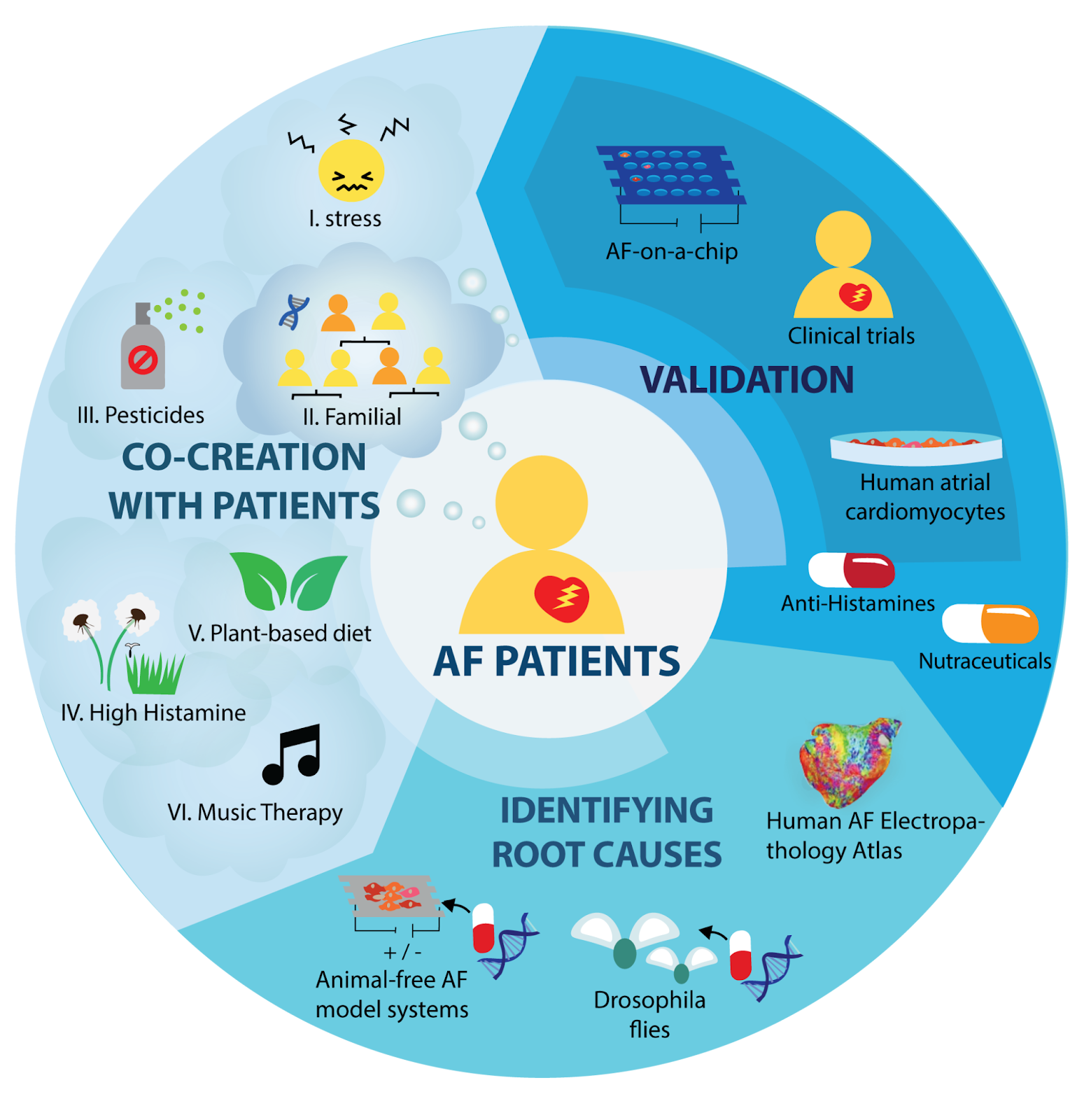
Our research team aims to stop Afib by using a holistic approach. At the heart of this approach is co-creation with people living with Afib to create scientific breakthroughs, such as uncovering the underlying mechanisms driving Afib, and societal breakthroughs in personalized therapy and diagnostic development.
Through citizen science – collaborating closely with people that have lived experience of Afib – we have already identified five major triggers for Afib. Together with people with lived experience of Afib, researchers, and health professionals, our research team aims to further explore these triggers.
Moreover, our experimental research aims to build the molecular human Afib atlas, a detailed map of the biological processes involved in Afib. This atlas serves as a foundation for new treatment discovery and biomarker research. Through co-creation with patients, we can test these new treatments in clinical trials that reflect the realities of daily life with Afib.
Because it will improve your life and our understanding of nuances in treatment effectiveness, underlying causes, mechanisms and triggers that can vary per person. Therefore, your insights are crucial.
MyAfib was created to bridge a gap in Afib management. Traditional treatments don’t work the same for everyone. The daily, lived experience of people living with this condition is often overlooked in conventional research about Afib, which mostly takes a ‘one-size-fits-all’ approach.
MyAfib takes a holistic and personalized approach to Afib care.
How do we do that?
- By providing clear, evidence-based information to help people better understand Afib. As a MyAfib member, you always have access to the latest Afib research and insights.
- By offering a personal dashboard that helps users track their symptoms, identify triggers, and monitor progress over time.
- By making it easy to share personal health data with cardiologists and other healthcare providers. We want to improve communication and help support more informed treatment decisions.
- By inviting individuals to participate in research, because we believe that your experiences can help shape the future of Afib management. At MyAfib, we empower you to use your own health journey as a valuable source of insight — not just for you, but for the entire Afib community.